
America the Bold
Stories you may have missed for a little detour from the Middle East

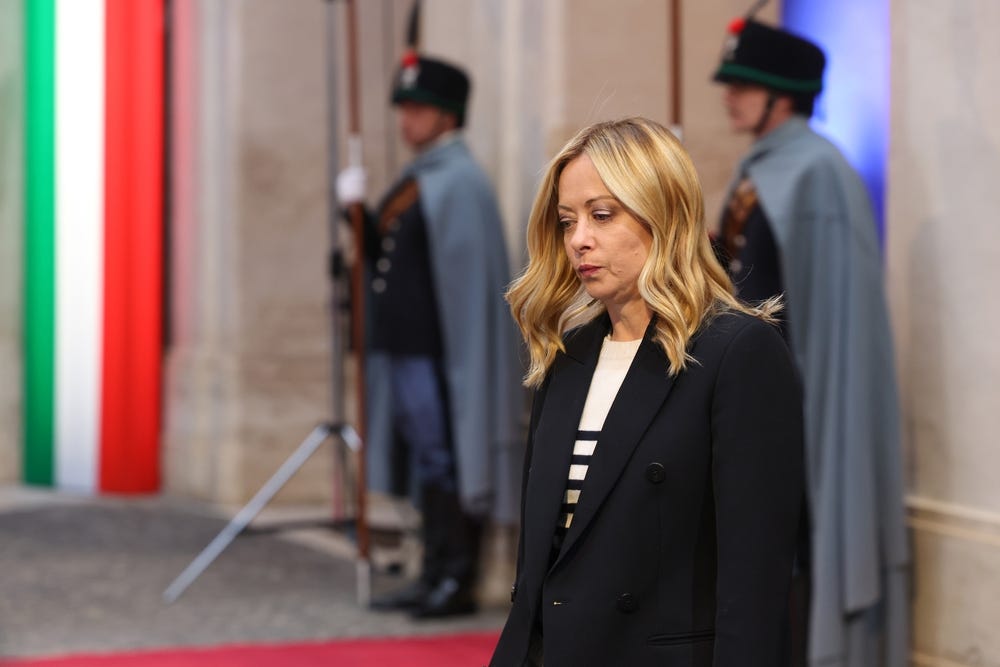
Not even the conservative Giorgia Meloni has escaped President Trump’s wrath
Hello from sunny Santa Barbara! While I may have the luxury of enjoying a break from my hectic lifestyle in Tennessee, I do not have the similar luxury of disengaging from the extremely complex and dangerous geopolitical situation many experts warn amounts to an unraveling of the entire world order. Indeed, you have a situation where a handful of powerful nations, including the United States, China, Russia, Israel, and Iran whose current policy of aggressively enforcing their national interests with little regard for the interests of smaller, weaker nations places the rest of the world in position of uncertainty at best and existential danger at worst.
This week, considering the highly fluid situation in the Middle East, where a US naval mission deemed Project Freedom to open the contested Strait of Hormuz by force was aborted as few ships dared to pass the Iranian-menaced passageway without risking destruction, I thought it necessary to look elsewhere and demonstrate the consequences, both positive and negative, of the ever-growing divide between the world’s great powers who set the agenda and middle powers who are forced to live with the consequences. With Europe in a state of total disarray and strategic impotence and much of Asia literally running out of fuel, the clock is ticking. However, there is one example that proves the Trump Administration right, and it’s right in our own backyard.
Triumph in Venezuela
The recent reforms in Venezuela are perhaps the strongest example where a great power acting unilaterally has manifested as a development for the greater good, rather than pure power politics. While the usual suspects hyperventilated in the immediate aftermath of the highly successful Operation Absolute Resolve that saw Venezuela’s criminal president Nicolas Maduro hauled off to prison, likely for the rest of his life, there is little doubt now of the degree of strategic benefit for the United States following Maduro’s dramatic downfall.
By 2025, years of expropriations, corruption, brain drain, replacement of technical experts with Chavista ideologues, and US sanctions had reduced Venezuela from a proud oil exporter to, in the words of one analyst, “the fallen angel of global crude markets.” Before Hugo Chavez took power in 1998, Venezuela produced more than 3 million barrels per day. By 2021, production had collapsed to barely above 600,000, mostly exported to China as few other nations had the leverage to defy US sanctions. To add insult to injury, Venezuela’s collapse also precipitated an environmental catastrophe on Lake Maracaibo, as rotting and leaky underwater pipelines have destroyed the ecosystem of the country’s largest inland body of water.
Now, with Maduro out of the way, Venezuela may turn out to be the Trump Administration’s biggest, though sadly underreported, success story. In recent weeks, executives from ConocoPhillips and ExxonMobil, burned by past expropriations, have ventured down to Caracas to test the waters and begin the process of rebuilding the nation’s ruined infrastructure. With full diplomatic relations now restored, the opportunity is golden. In recent months, these executives have met directly with Venezuelan President Delcy Rodriguez, who in a total U-turn from Chavista doctrine recently approved major free-market reforms in the oil sector. While no major investments have been approved yet, Exxon CEO made positive hints about the future: “Venezuela is a huge resource that’s now opened up more freely to the world.” On the ground, production is on the upswing, with more than 1 million Venezuelan barrels per day exported on average in April, mainly to the US Gulf Coast where the crude is refined and shipped around the world.
It’s most unfortunate that the Trump Administration’s Venezuelan triumph has been underreported by a legacy media eager to underscore our misadventure in Iran. While the path towards fair elections, substantial economic recovery, and ultimately a total dismantling of the Chavista system remains long (Rodriguez and her cohort are understandably keen to avoid Maduro’s fate), Venezuela proves that with the right measures, even the most hostile regimes can soften their rough edges.
Transatlantic Rupture
It should be no secret to anyone that Donald Trump despises Europe— albeit not its people, but its political elites. The 47th President has for decades, and will for the rest of his life, believe that European governments have unfairly been subsidized by American taxpayers and will forever leverage, in full Art of the Deal mode, the vast economic and military might of the United States to rectify an unacceptable transatlantic imbalance. Since he launched a war with Iran more than two months ago, the President has vented his frustration at multiple European leaders, claiming that without his decisive action, Iranian nukes would be menacing Rome, Berlin, and London, and Europe’s refusal to support Operation Epic Fury against Iran is nothing less than an epic betrayal.
This week, his harsh words have turned into action, with threats to hike tariffs on European automotive imports and announcement that thousands of American troops will depart Germany within a year. As Germany is home to by far the largest US Armed Forces deployment in Europe, the world will take notice. While Congress has acted to tie the hands of the administration from making deeper cuts, the action is a powerful symbol of the wholesale rupture that has occurred between the United States and nations who were once its closest allies.
I make no bones that I am quite sympathetic to the so-called Old Continent, albeit sometimes excessively to the point of almost demeaning my own country. After all, Europe is where the history of Western Civilization was forged for centuries before suffering two devastating World Wars from which, in my opinion, the continent has never fully recovered. I also have several European friends, some of whom even read this blog. While I can assure all my readers that my personal loyalties have not and will not reposition themselves across the Atlantic and I will remain an American at heart first and foremost, I will always have a soft spot for the place, a soft spot that Donald Trump obviously lacks.
And that is why I am deeply saddened that transatlantic relations, once the bedrock of the global economic and security systems, seem permanently ruptured. President Trump is despised in Europe, even by right-wing and conservative leaders such as Italian Prime Minister Giorgia Meloni. Operation Epic Fury was also deeply unpopular there, strengthening the hands of European governments who will not, under any circumstances, engage in combat operations against Iran. And the American President is not a man who ever forgives or forgets, closing the door to any hope of reconciliation. In my humble opinion, it would be best for all of us, both in America and Europe, for the sake of decency and the future of Western Civilization to work out our differences.
While Europe may no longer be an equal to the United States, Washington slamming the door the place would only damage both sides.
You may be thrilled with the Trump Administration’s assertive, unilateralist, and even aggressive America First foreign policy. You may also deeply resent it. However, whether for good or ill, there is no doubt that this policy has changed the course of humanity for years to come. Weaker powers, whether the new and reformed Venezuela, Italy, Canada, India, or anyone else have little choice but to come to terms with this inescapable reality.